When Equipment Fails, The Risk Is Real: How to Actually Trust Your Lined Vessel Supplier
Published on: August 27, 2026 Topics: Linings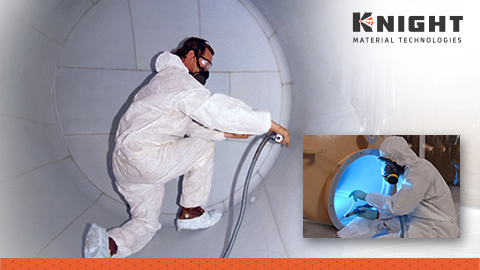
A single tank failure in California made national news. When a refrigeration system malfunctioned, methyl methacrylate inside the tank began to polymerize; pressure built, and the result was a mandatory evacuation for 50,000 people.
While the failure wasn’t tied to the lining inside the tank, this incident illustrates vividly how a nightmare scenario can develop from a single incident, disrupting thousands of lives, upsetting operations and damaging a company’s reputation. Hazardous chemicals are transported and stored in thousands of locations across the country, and companies need to rely on the integrity of the vessels used for transportation and storage. Some of these vessels require a lining to protect the interior surface, and companies look for 10 to 20 years of service.
In the quest to maintain asset integrity, how can you verify prior to tank lining or a lining repair, that the job will be done right and supply the service life required? Here are three questions worth asking any lining supplier or fabricator. First, a look at the types of linings available.
What is the purpose of the bonded fluoropolymer lining in the vessel?
Bonded fluoropolymer linings solve a basic materials problem: many process fluids such as strong acids, high-purity chemicals or aggressive solvents will corrode or contaminate bare steel tanks or vessels over time. Bonding a fluoropolymer sheet (PFA, PTFE, FEP, and others) to the interior wall isolates the steel from the process chemistry.
The specific polymer selection matters immensely. For example, PFA and FEP are fully fluorinated, flexible and can theoretically handle service above 400°F. In many cases, however, PVDF and ECTFE pose an acceptable solution if they can perform within specifications, and might be selected due to lower cost. The right choice for the fluoropolymer lining depends on the process chemistry involved and the temperatures it might encounter, so it will supply the performance and lifespan the application requires.
The bonding itself is key, and it must address a challenging problem. Fluoropolymers are inert almost by definition, which means nothing adheres to them directly. As one solution, the sheet will have a fabric backing mechanically embedded onto one side of its surface face. Fibers are pressed into the polymer, leaving enough of the fabric exposed to give the adhesive something to grip. The adhesive is applied to the steel substrate and the fabric-backed fluoropolymer sheet, with the sheet then pressed into place.
The lining’s success depends on this mechanical anchor or sandwich, of polymer to fabric, fabric to adhesive and adhesive to steel. The following questions relate to the integrity and strength of the links in that chain.
Why is trust the real product being sold?
Choosing a lining system is, to a significant degree, a trust exercise. The adhesive systems that bond fluoropolymer sheet to steel are proprietary. In fact, every serious fabricator has spent years developing its own formulations. This means there are no public spec sheets to compare for the various suppliers. There’s a system, engineered for a specific application, backed by a specific company’s track record.
That’s not a reason to be nervous about lined equipment. It’s a reason to ask sharper questions before you buy, and a reputable fabricator will welcome these questions.

Question 1: What adhesive system are you using, and why?
There is no one-size-fits-all adhesive. A system built to flex with a tank trailer bouncing down the highway needs to move with the steel, since some over the road tanks can flex by an inch or more in transit. The bond has to be elastomeric enough to absorb that movement while still holding the lining in place. That’s a completely different scenario from an adhesive built to survive a stationary vessel running at 250–300°F consistently for two decades, day in and day out, where flexibility matters far less than long-term thermal stability. Chasing both properties in a single adhesive is a losing trade-off; the systems that handle high heat well tend to be the ones that crack under mechanical flexing and vice versa.
A supplier or lining operation should maintain more than one proprietary system for exactly this reason. Any lining company should ask about your actual service conditions, such as temperature, chemistry, whether the vessel is stationary or moves, before recommending one. If a fabricator gives you the same answer regardless of application, that’s worth noticing.
How is the liner actually installed?
Sheets are applied section by section, closer to hanging wallpaper than laying down one continuous piece. Size is limited by what a crew can realistically maneuver through a manway and handle by hand. A 4×8 foot PFA sheet already weighs more than 30 pounds, so the fabricator is balancing sheet size against worker handling and the number of welds needed to join sections together.
Once a sheet is positioned and adhesive applied, vacuum bagging, rather than mechanical pressure or magnets, is used to press the sheet into place and pull out trapped air. Vacuum gives even, consistent force across the entire bonded area, a result difficult to achieve with any other method.
Shell sections are typically lined with rectangular sheets, but dished heads need a different approach: they’re lined with thermoformed pie-shaped sections around a center disc, rather than one continuous piece, so that all the seams don’t converge at a single point and create a weak spot.
Question 2: What failure mode shows up in your testing — and does it hold up under real stress?
The industry standard is a climbing drum peel test, measuring how much force it takes to separate the liner from the substrate, in inch-pounds per inch. But the number alone isn’t the whole story, whereas the failure mode is. The gold-standard result isn’t the adhesive letting go, and it isn’t the polymer separating from its fabric backing. It’s the fabric backing itself failing. This demonstrates that the bond between the adhesive and the steel, and the bond between the adhesive and the polymer lining, were both stronger than the weakest structural component in the system, or the fabric backing itself. When that happens, the system is working exactly as it’s designed to work.
The climbing drum peel test (ASTM D1781) measures how much force it takes to separate the liner from the substrate, in inch-pounds per inch. The number matters less than how the sample fails. Electro Chemical Manufacturing (ECM) tests bond strength to ASTM D-903, and the result to look for is the fabric backing tearing before the bond does. That means the adhesive-to-steel bond and the adhesive-to-polymer bond both outperformed the weakest structural link in the system: the fabric backing itself. When the backing fails first, the lining system is working exactly as designed.
This is also where material selection matters. Fabric backings aren’t interchangeable across chemistries: glass fabric works well with fully fluorinated resins like PFA, but it has no place in hydrofluoric acid service, where an aramid backing might pose a better choice. A supplier who can explain that trade-off, rather than defaulting to whatever’s on the shelf, is showing you they understand the chemistry, not just the mechanics.
Just as important as the failure mode is the condition under which it was produced. A peel test done at room temperature on day one tells you very little about year ten. The best test is a simple one: hot water stresses the entire bonded surface area at once and exposes voids or trapped air that a spot check might miss. Ask for the failure mode and ask what method was used to determine it.
Question 3: What’s your verification process once the vessel is built?
Bonding and welding the sheets is only half the job — verification is what tells you the work actually holds up before the vessel ever sees process chemistry. Standard practice typically includes:
- Visual and tap testing: checking the bonded surface by hand or with a rubber mallet; a change in tone indicates a void or delamination behind the liner.
- Spark testing: conducted after welding to detect pinholes or flaws in the weld itself. Effective, but it has to be done by technicians with experience and done carefully: if the voltage is too high or the spark testing spends too much time in one spot, it can damage a good weld.
- Helium leak testing: this is a more sensitive method than spark testing, capable of detecting flaws roughly 100 times smaller than spark testing capabilities. It is also non-destructive. This process is usually reserved for new lining installations and is offered by just a handful of companies in the industry.
It’s also worth asking what happens if something is found. A void behind the liner can sometimes be repaired by injecting adhesive into the affected area; a more serious issue may mean cutting out the sheet and replacing it entirely. Either way, a fabricator who documents the finding, the fix, and the re-verification in a formal non-conformance report is showing you a process built for accountability, not one that hopes problems don’t surface.
One more signal worth checking
Beyond the three questions above, it’s worth asking whether the staff is involved with ASME or industry standards committees that define how these vessels should be built and tested. That is a meaningful signal, which means the quality control process was designed by people who understand failure modes at the deepest level.
The bottom line
Lined vessel failures rarely make the evening news the way that large-scale evacuation in California did, but the underlying principle is the same. The difference between a reliable asset and a liability comes down to the discipline behind the bond and the lining selection, discipline that stays invisible until inspection time, or until a problem develops in service.
At Electro Chemical Manufacturing (ECM), a division of Knight Material Technologies, that discipline is the whole job: application-specific adhesive systems, testing that pushes past ambient conditions, and verification at every stage of fabrication. It’s what lets a lined vessel pass its next inspection, and the one after that, for the full 10 to 20 years of its potential service life. Contact us to discuss your next tank lining project.
Michael Krauss, Sales Director – Fluoropolymers and Dual Laminates at Knight Material Technologies goes deeper on the bonding chemistry in a Corrosion Chronicles podcast that you can listen to in full here.